British and Canadian snipers in World War II were among the best trained and most efficient soldiers on the battlefield.
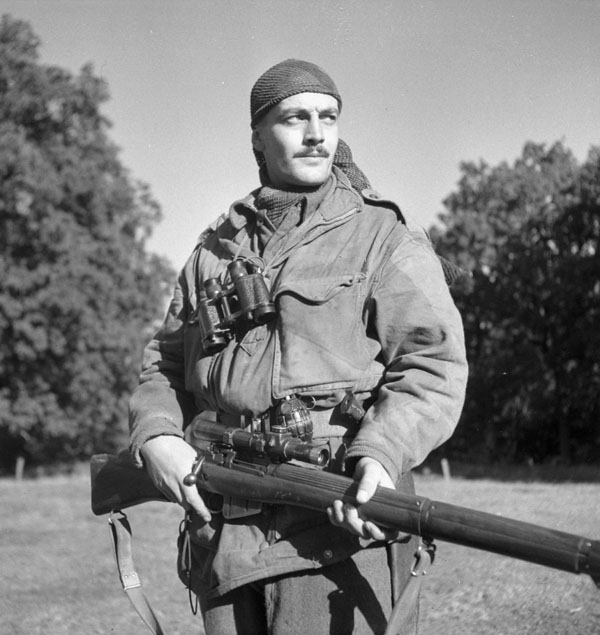
Theirs is a very important job and in recent years, armies have come to understand that having their own snipers means many lives of their own soldiers are saved and great damage is done to the enemy.
The sniper is the ultimate in efficiency. One shot, one kill – be it an enemy officer, crew-member of a weapons such as a machine gun, or special equipment such as a computer, radio, weapon, vehicle or aircraft.
Many people find the sniper’s job distasteful because a sniper looks through a scope at a human being that they are about the kill. Many of those who feel this way seem to believe that killing by shooting a machine gun, lobbing a mortar bomb or artillery shell, dropping a bomb, firing a torpedo or shooting an airplane down is somehow more humane or noble. In reality, a sniper verifies that the enemy whom he or she is about to shoot is indeed the enemy, and is often a high priority target such as an enemy sniper, enemy officer, radio operator or crew-served weapon operator. Snipers know that by “taking out” their targets, they are saving the lives of some of their fellow soldiers and civilians.
Snipers have long been vilified by their enemies, who fear him or her, and by fellow soldiers, who view them as outcasts. That has been changing and by 2015, one’s own snipers are viewed as protecting and avenging angels. The term “overwatch” is frequently used as they “cover your back”.
The sniper is the ultimate in efficiency. One shot, one kill – be it an enemy officer, crew-member of weapons such as a machine gun, or more recently, special equipment such as a computer, radio, weapon, vehicle or aircraft.
Today Britain and the United States are probably the World’s leaders in sniping rifles, technology etc. Interestingly the U.S. was a pioneer in sniping, as far back as the U.S. Civil War, however their sniper programs were very slow and poorly equipped in various wars and the U.S. military constantly shut down their sniper programs between wars. As a result, the U.S. equipment was often substandard and the Americans lagged far behind the Allies and the enemy up until the middle of the Vietnam War. The American weapons were usually one war behind. e.g. the M1C and M1D were both developed in 1944. The M1C saw extensive use in the Korean War and the M1D saw use after the Korean War. They have made up for this lag since then.
TRAINING FILMS
WANTED: A copy with sound of the British training film “I’M A SNIPER” Army film # C.915 (also numbered B.915).
“I AM A SNIPER” This training film was approved in September 1945 and features the use of the No. 4 MK. I (T) Lee-Enfield sniper rifle and the Scout Regiment Telescope. I showed ithis fil, to the men of the Reconnaissance Platoon that I commanded in the Seaforth Highlanders of Canada back in the early 1970s. I would love to have a copy of it now, with sound, in any format. It was still in use in training Canadian snipers in 1993. Happily, the Imperial War Museum has now posted a copy of this film, though sadly this version is without sound. Their number is Film: IWM (DRA 915). They styate that it is 35 mm but the one I showed to my platoon was 16 mm, which was a standard size for training films, so I suspect thet they made a mistake.
WEAPONS AND EQUIPMENT SEEN IN THE FILM
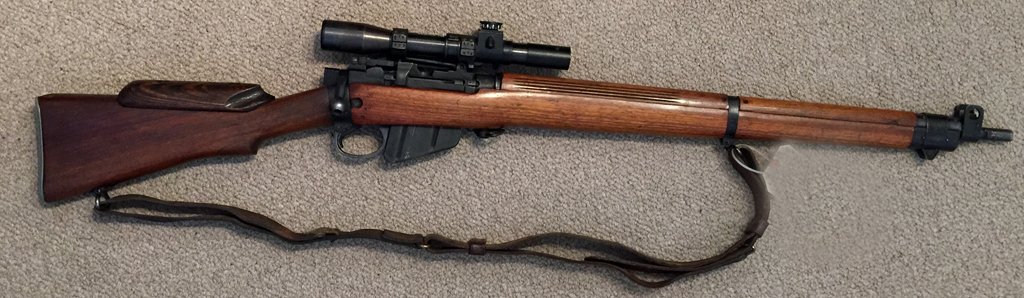
- Rifle, No. 4 Mk. I (T) sniper rifle .303″ with No. 32 Mk. 3 scope (3 times magnification) and M1907 leather sling.
- Sten Gun Mk. 3 9X19 mm Machine Pistyol (submachine gun)
- German machine pistol (submachine gun) MP-40
- German assault rifle MP-44 7.92 mm Kurz
- Denison scocks – Camouflaged baby jackets with pockets. Crotch strap keeps it from riding up if the man has to crawl backwards. Originally designed for Airborne Troops.
- Face veil, camouflage colours, worn over the top, sides and back of the head, and draped over the shoulders.
- Balaclava
- Binoculars, 6 times magification
- Scout Regiment Telescope Mk. II s, 20 times magnification.
- No. 8 Mk. I scope case (cleaning gear scene)
- Prismatic Compass
- Map & map case
- Watch GS ( General Service)
- Field Telephone, connected by wire back to their own lines behind them.
Film length is 50 minutes 51 seconds.
NOTE: The IWM’s posting of this film is in five (5) segments. Below the main screen are five small boxes:
1/5 Running time – 10:34 Sniper tream stalking and spotting Germans. Then the sniper’s quarters where a sniper section of 8 men are cleaning equipment and relaxing. Flashback as to the jobs snipers had in civilian life. Then they are summoned to an “O Group” with the Intelligence Officer who briefs them on their mission. Then the film follows one team as they head off, one with a No. 4 Mk. I (T) and the other with a Sten Gun Mk. 3. No webbing, but items tucked into pockets of their Denison smocks which have a bits of scrim attached . They are in a firing position, and have identified a target but the Observer checks his watch and signals a 5-minutes wait, presumably to coincide with a planned attack. The noise of an attack would tend to mask a sniper’s shots and firing early could alert the enemy.
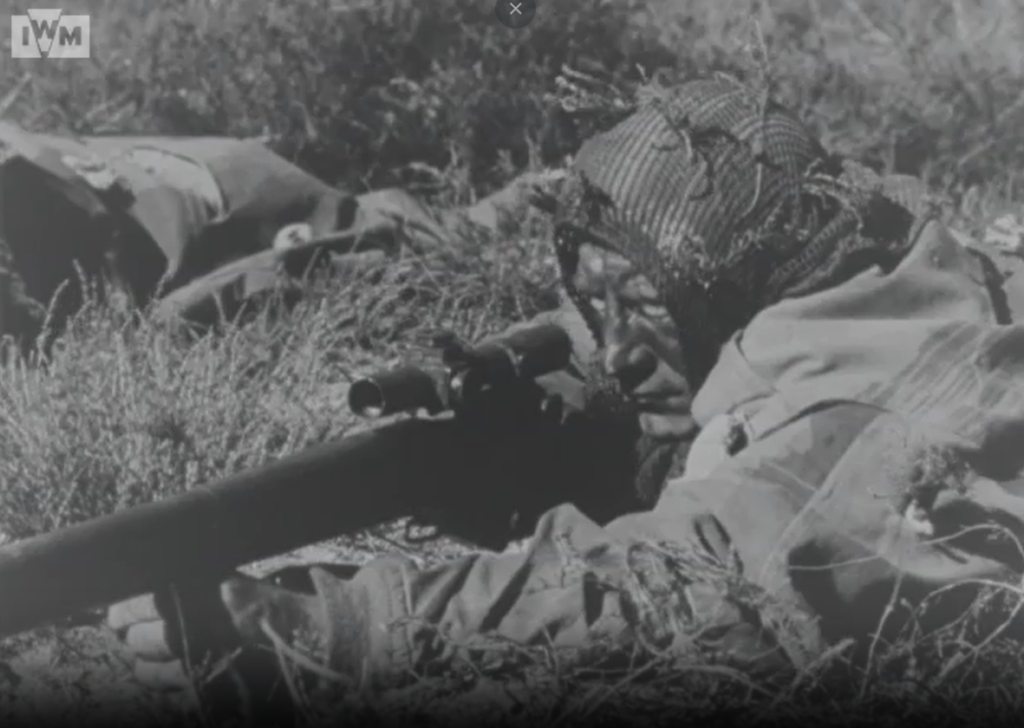
2/5 Running time – 9:56 “Monkey run” on hands and knees, slowly, clearing twigs out of the way with their hands. Then a sudden sprint (perhaps they had come under fire?) and quickly dropped down behind cover. Then Leopard crawl, Russian version. The sniper adopts a Hawkins position, i.e. rifle low with left hand on ground and grasping sling and front swivel. Sniper adjusts his range drum. The clouds shift and reveal a full moon. They observe a German running across a road and into a bushy area. An enemy patrol of 6-men leaves a tree line and enters an open area. The leader, with an MP-40 is shot by the sniper. The enemy returns automatic fire with an MP-44 Assault Rifle. The Observer, using binoculars, spots the man with the MP-44 and directs the sniper who then shoots him. The surviving enemy scramble away. The sniper starts to crawl backwards. The team Leopard Crawls and enters a ditch. On can see that the Observer is carrying a Scout Regiment Telescope in is case, slung on his left side. The lead man lifts up a hessian (?) cloth and enters the hide. This cloth is closed behind them so that when they open a front vieing hole, they will not be silhouetted. Then each man slowly opens a front cover for their opening. The Observer then uses his Scout Regiment Telescope. They search the ground out front, right to left initially.
3/5 Running time – 10:16
One man tugs on a line tied to a bush that is some distance from their hide. This is a decoy to see if the enemy are present. If the enemy fires at the movement, it could give away their position. Then the Observer picks up a dummy head that was in the hide, the front openings are closed, the Observer exits and the rear opening is closed again. He crawls to a deserted ruined house nearby while the other man watches, holding the Scout Regiment Telescope. The man in the house, with Sten Gun at the ready, carefully climbs the stairs to the floor above. He “Monkey Runs” (hands and knees) crawls to a position inside a room, below a window. He carefully lifts the dummy head on its stick and slowly moves it as if it is a human peeking out from different angles. Finally a shot hits the head. The sniper, back in the hide uses the Scout Regiment Telescope to spot the German sniper up in a tree (not a good place to be!). Then he picks up his rifle and shoots the enemy sniper. In the next scene a man is observing with the Scout Regiment Telescope and spots two Germans at the edge of a wood.
In daylight, a different sniper moves up into the attic of a house. An observer is there and briefs him on the terrain with the help of a map.
4/5 Running time – 10:11
Looking through existing holes in the roof, they search with binoculars and a Scout Regiment Telescope. A note is made of their observation. Using the binoculars, the Observer tells the sniper of a suspicious location. The sniper checks it with the Scout Regiment Telescope, and then takes a compass bearing while the Observer writes it in their log book. Probably an enemy machine gun position. A suspicious building with some roof tiles missing catches their attention. It looks like they called for artillery fire on a target because they congratulate each other.
Another sniper team, each armed with a sniper rifle, a flashback to their briefing by the Intelligence Officer. They lay out their kit on a table, preparing for a mission.
Observer’s Kit – Sten Gun Mk.3., face veil, Prismatic Compass (carried in external left chest pocket of smock); Watch G.S. (carried in inner chest pocket on left side of smock); Scout Regiment Telescoope in its leather carrying case; map; Blaclava face veil; two primed No. 36 M Mk. I hand grenades and two loaded magazines for the Sten Gun.
Sniper’s Kit – Binoculars with some hessian wrapping as camouflage and the carryting strap tied to shorten it so that it is worn arround the neck and tucked into the front of the Denison smock,. Camouflage face paint applied using a mirror; Balaclava; Removing personal papers to leave behind in a small pack. Two primed No. 36 M Mk. I hand grenades, one in each bottom front pocket of the Denison smock. There is a bandolier of 50 rounds of .303 ammunition in chargers (stripper clips, but with the scope on the rifle thay would have to be loaded one at a time into the magazine), but he appears to only take 10 rounds out of the bandolier or maybe a few more. The sniper ensures that the two large knobs securing the scope bracket to the rifle are secure. He then checks the settings on range and windage. dials.
They head off and into a ruined building and observe the terrain, staying well back from the window openings.
5/5 Running time – 9:54
The Scout Regiment Telescope has a face veil draped over it, but not in front of the lens. They leave the building and pass through a small wood, into a field with scattered bushes. 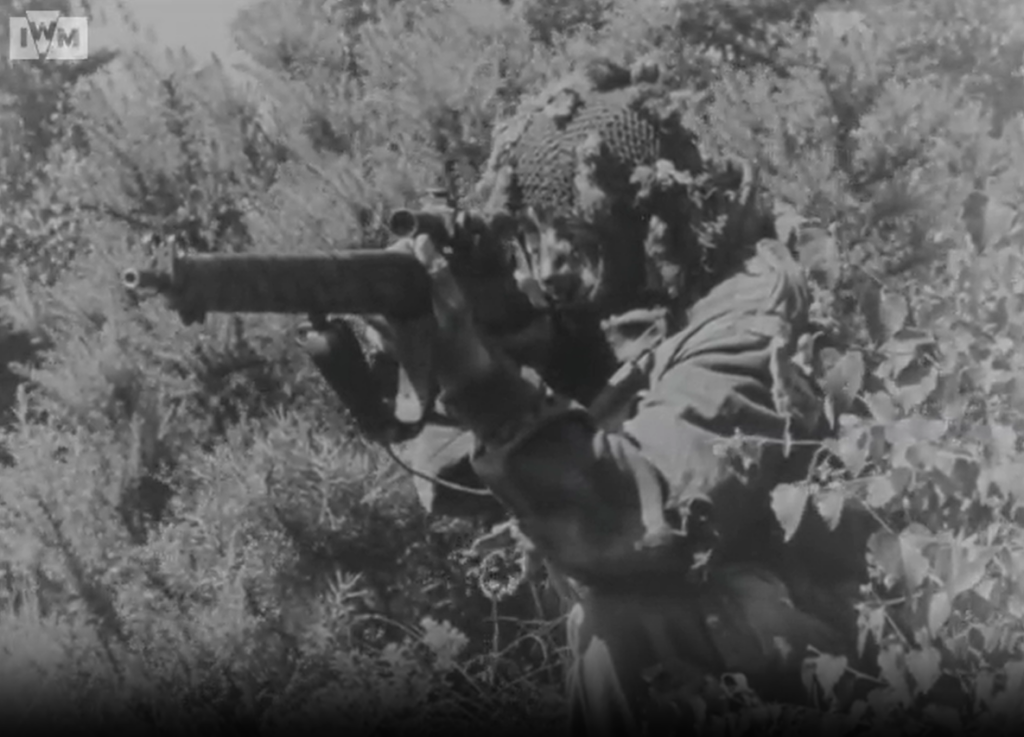 I’m a Sniper
At a treeline, there is a road they cross by rushing across together in case the enemy had weapons covering it. Then they quickly get down on their bellies in the tall grass on the other side of the road. The sniper observes with binoculars while the observer moves up behind a bush (cover from view, not from fire), opens up the Scout Regiment Telescope and drapes a face veil over its body as camouflage. Leopard Crawl, Russian version. They take up a new firing position in bushes at the edge of a field. The sniper shoots a German. The other Germans reply with a machine gun, not knowing exactly where the sniper is. A second German is shot. The sniping team then withdraws
The film then dows a quick review of what it just covered.
Click on the link below to watch the first segment film “I’M A SNIPER”, then click on the boxes just below the main screen to view the other 4 segments.
https://www.iwm.org.uk/collections/item/object/1060008775
“KILL OR BE KILLED” 1942 British Army training film for snipers. The British sniper is using a standard No. 1 MK. III with iron sights. By 1942, a few No. 3 (T) and No. 4 (T) were in the system. 17 minutes 29 seconds With sound. Available on-line through the Australian War Memorial ID Number FO1761 https://www.awm.gov.au/collection/F01761/ Thank you to Dean Bryan in Nottingham, England for providing the link.
MOVIES
“THE SIEGE OF JADOTVILLE“ (2016) About an Irish Army Company serving with the United Nations that held off a superior attacking force in the Congo in the 1960s. . Lots of Lee-Enfield in use including a No. 4 MK. I (T) as well as L1A1 FNs and Bren Gun. Made for NETFLIX. Shades of “Saving Private Ryan” the sniper in the movie is once again left-handed and shooting a right handed rifle. The full movie is now on YouTube. Sniper rifle at 37 minutes in shows scope reticle less the horizontal wire. 1hr 44 minutes 33 seconds.
PHOTOGRAPHS
Link to my page on Photographs of Snipers
Milsurps dot com has a Knowledge Library with many detailed photos of firearms including various sniper rifles.
SNIPING
A small sampling is shown below. There are many makes, models and variations.
AUSTRALIAN WWII SNIPER RIFLES
Pattern 1914 with Pattern 1918 scope
No. 1 Mk. III* with Pattern 1918 scope. Australia built her own sniper rifles using a heavy barrel version of the No. 1 MK. III* rifle. There were two basic mounts – high and low. They continued to use these through World War II and Korea.
BRITAIN
After World War I, Britain dismantled the majority of its sniper rifles. These were mainly SMLE rifles equipped with a variety of scopes. The late war No. 3 MK. I (Pattern 1914) rifles fitted with scopes were farmed out various Commonwealth countries. Canada only acquired two of these. In 1941 Britain had the No. 32 MK. I telescope, designed for the Bren Gun but never installed (which is why the “windage” knob is on the left side so that access to it would not be blocked by the Bren Gun magazine which sits on top of the gun). The Royal Small Arms Factory at Enfield installed No. 32 MK. I scopes onto 1,403 Lee-Enfield No. 4 Mk. I rifles, thus creating the No. 4 MK. I (T) sniper rifle. They then contracted with Holland & Holland to convert more rifles in late 1942. Roughly 26,000 No. 4 rifles were converted to sniper equipment overall.
Most of the Canadian made No. 4 MK. I* (T) rifles and their scopes ended up going into British service. They were intermingled on issue to any Commonwealth country and during rebuilds, Canadian made rifles often ended up with British made scopes and/or brackets being installed. See the “CANADA” section for those models. The rare book “An Armourer’s Apprentice” by Peter Laidler is the prime reference for the production of the No. 4 (T) sniper rifles, dealing with quantities, technical aspects etc.
Recommended books about British WWII sniping:
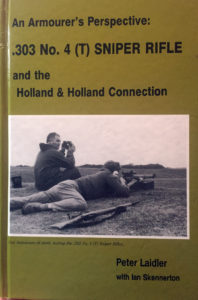
- AN ARMOURER’S PERSPECTIVE: .303 No. 4 (T) SNIPER RIFLE and the Holland & Holland Connection by Peter Laidler with Ian Skennerton 1993. OUT OF PRINT and rare.
- THE BRITISH SNIPER British & Commonwealth Sniping & Equipments 1915 – 1983 by Ian Skennerton. 1983. OUT OF PRINT and rare.
- THE LEE-ENFIELD – A Century of Lee-Metford and Lee-Enfield RIfles and Carbines by Ian Skennerton 2007
- TELESCOPE SIGHTING No. 32 MK I – OS 466A MK 2 OS 1650A MK 3 – OS 2039A Including the No. 42, 53 & L1A1 by Peter Laidler 4th Edition 2008 BDL, Ltd., 410 Meeting Street Road, Edgefield, SC, 29824, USA Usually OUT OF PRINT and rare.
- THE SNIPER by Barry Wynne 1968 – The story on one sniper throughout the war. Biography. OUT OF PRINT and rare. Hardcover and softcover editions.
-
WITH BRITISH SNIPERS TO THE REICH by Captain C. Shore, 1948
- NEW! THE BRITISH SNIPER – A Century of Evolution by Steve Houghton, Swift & Bold Publishing (2019). It may be ordered from them at swiftandboldpublishing@gmail.com It is large, heavy and receiving excellent reviews. Price is about GBP 57 plus postage from the UK.
British Sniper Rifles (to the 1980s Falklands War)
- SMLE with side mounted scope
- No. 3 MK. I (T) A (P-14 rifle with Aldis scope)
- No. 3 MK. I (T) (P-14 rifle with Pattern 1918 scope)
- No. 4 MK. I (T) or No. 4 MK. I* (T) with a No. 32 or a C No.67 scope
- L42A1 with L1A1 scope. (Converted to 7.62mm from No. 4 MK. I (T) and No. 4 MK. I* (T) sniper rifles. In use circa 1970-1993) Guns and Ammo created a video review of the L42A1 in 2007. The rifle used was a Long Branch No. 4 MK, I* (T) that was converted by the British at Enfield into an L42A1.
British Sniper Rifle Scopes
- Aldis
- Model 1918 (mistakenly called Pattern 1918 by many people)
- Winchester A5
- No. 32 MK. I
- No. 32 MK. I/1
- No. 32 MK. II
- No. 32 MK. 2/1
- No. 32 MK. III (sometimes marked as No. 32 MK. 3)
- L1A1 (1970s-1980s conversion of No. 32 MK. III for use on L42A1 rifle, calibrated for 7.62mm)
British Observation Equipment
- Scout Regiment Telescope Mark IIs
- Binoculars
CANADIAN WWI, WWII & POSTWAR SNIPER RIFLES
Canada made a version of the British No. 4 MK. I (T) sniper rifle using a Long Branch No. 4 MK. I* rifle, so it was the No. 4 MK. I* (T). There were some minor variations. The telescopes were mainly made by Research Enterprises Limited (R.E.L.) in Canada, and some were purchased from Lyman in the U.S.A. when not enough R.E.L. scopes were available.
Sniper Rifles
- Ross Mark III (M-10) fitted with Warner & Swasey Model 1913 Scope
- Ross Mark III (M-10) fitted with Winchester A5 scope
- No. 3 MK. I (T) A (P-14) fitted with Aldis scope
- No. 3 MK. I* (T)
- No. 3 MK. I (P-14) fitted with Warner & Swasey Model 1913 Scope
- No. 4 MK. I (T)
- No. 4 MK. I* (T)
Sniper Rifle Scopes
- R.E.L. C No. 32 MK. I
- R.E.L. C No. 32 MK. IA (MK. I upgraded)
- R.E.L. C No. 32 MK. II
- R.E.L. C No. 32 MK. III (or C No. 32 MK. 3)
- R.E.L. C No. 32 MK. 4 renamed C No. 67 MK. I as it was quite a different scope.
- Lyman No. 32 TP MK. I (TP = Trade Pattern) as per the EME manual. Sometimes written as No. 32 MK. I TP . This was a Lyman Alaskan scope with the serial number on the tube and on the base of the upper turret. Earlier research said 99 were purchased, but it is now known that 350 were purchased. Serial numbers were 5 digit: 4 numbers and “S” e.g. 4407S. All of those seen by me have a British issue mark broad arrow /|\ following the serial number, even though these scopes were only on Canadian, not British, issue. We do not know why the British /|\ was put on.
Post-WWII Canada has used a variety of sniper rifles.
- M1C with Infrared .30/06
- M1D .30/06
- FN C1A1 with C1 scope 7.62mm
- Parker-Hale C3 with C2 scope (Kahles ZF 69) 7.62mm
- Parker-Hale C3A1 with C3 scope (Unertl 10X) 7.62 mm
- C15 McMillan TAC-50 (long range) .50 Cal
- Prairie Gun Works (PGW) Coyote 7.62 mm (for training)
- Prairie Gun Works C14 PGW Timberwolf .338 Lapua (Medium range, for operations)
Canadian Observation Equipment
Videos of Canadian snipers:
- Black Watch Snipers (WWII Canadian veteran snipers and re-enactment of their stories)
- How Canada’s small military produced deadly, record-breaking snipers 2.2 mile shot
GERMAN WWI & WWII SNIPER RIFLES
In World War I Germany was a leader in sniping. Many soldiers had civilian experience hunting with telescope equipped rifles. Germany had the World’s best optical manufacturers and they entered the war leading the field in machine guns and sniper rifles. After WWI Germany’s military was drastically cut back upon orders of the Victorious Allies.
The main German sniper rifles were:
- WWI
- Gewehr (rifle) 98 (Gew 98) fitted with a scope
- WWII
- Kar98k with ZF-41 scope (1.5X). This was really more of a marksman’s rifle, rather than a sniper.
- Kar98k with turret mounted scope
- Kar98k with side rail mounted scope
- Kar43 semi-automatic with ZF-4 scope
INDIA
- India is known to have used some No. 4 MK. I (T) and No. 4 MK. I* (T) rifles. These usually have the Ishapore screw added (a cross-bolt through the forearm, in front of the magazine) and may have British markings “scrubbed” (i.e. removed.) These rifles usually show a lot of wear and tear.
- No. 4 MK. I (T)
- No. 4 MK. I* (T)
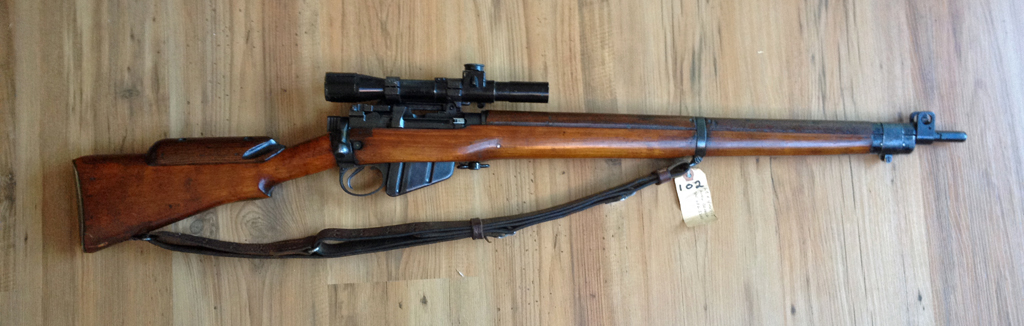
No.4 MK. I* (T) sniper rifle made by SAL at Long Branch in Canada. Serial number 68L3200. This one has the Ishapore screw which was a typical Indian military modification. Right side of whole rifle shown. The scope shown is a mismatched original No. 32 MK. II scope. This rifle was found in a Canadian collection.
- No.4 MK. I* (T) sniper rifle made by SAL at Long Branch in Canada. Serial number 68L3200. This one has the Ishapore screw which was a typical Indian military modification. Right side of whole rifle shown. The scope shown is a mismatched original No. 32 MK. II scope.
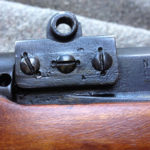
- No. 4 MK. I* (T) The front scope pad shows partly obliterated markings which are the Canadian Maltese Cross (meaning non-standard parts) and an upside down “T”. The screws are double staked (to prevent screws coming loose) indicating heavy use.
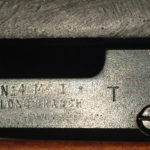
- No. 4 MK. I* (T) made by SAL at Long Branch and later issued to the Indian military. The left side of the body has “No.4 MK. I* T” over “LONG BRANCH” over the year 1944. Note that Long Branch is two words. Apparently sandblasting , likley by the Indian military, has partly erased the markings. The markings are: No 4 MK I * T / LONG BRANCH / 1944.
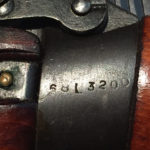
- No. 4 MK. I* (T) made by SAL at Long Branch and later issued to the Indian military. Serial number 68L3200. No “TR” stamp on the Canadian made rifles.
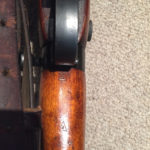
- No. 4 MK. I* (T) made by SAL at Long Branch and later issued to the Indian military. Serial number 68L3200. The butt is a U.S. Stevens-Savage made one fitted later in service. Note that their mark for the wood is a squared “S” in a box. The triangle with a “J” mark might be Indian.
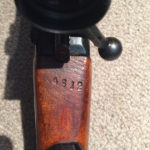
- No. 4 MK. I* (T) made by SAL at Long Branch and later issued to the Indian military. This is the serial number of the British scope that was assigned to this rifle in Indian service, a No. 4 MK. I # 4612. The number is stamped on top of the wrist of the butt, just behind the cocking piece. The rifle would have originally been fitted with a Canadian Long Branch butt and an R.E.L. made scope but the butt and scope were changed in Indian military service.
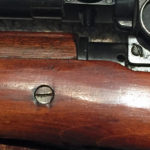
- No.4 MK. I* (T) sniper rifle mae by SAL at Long Branch in Canada. Serial number 68L3200. This one has the Ishapore screw which was a typical Indian military modification. Left side shown.

- No.4 MK. I* (T) sniper rifle mae by SAL at Long Branch in Canada. Serial number 68L3200. This one has the Ishapore screw which was a typical Indian military modification. Right side shown.
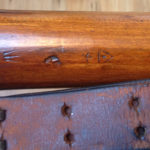
- No. 4 MK. I* (T) made by SAL at Long Branch and later issued to the Indian military. Serial number 68L3200. The underside of the forearm in front of the magazine has unusual markings which are believed to be Indian military (e.g. trident shaped stamp and “F” inside a triangle).
- No. 4 MK. I* (T) made by SAL at Long Branch and later issued to the Indian military. Serial number 68L3200. This is the serial number stamped into the underside of the forearm, near the muzzle. The forearm appears to be locally made in India and it has been serial numbered to match the rifle serial number. It did not leave the factory with a serial number there apparently.
JAPANESE WWII SNIPER RIFLES
- Type 97(i.e. 1937) Arisaka in 6.5mm with 2.5X scope.
- Type 99 (i.e. 1939) Arisaka in 7.7mm with 4X scope
UNION OF SOVIET SOCIALIST REPUBLICS (U.S.S.R.) WWII SNIPER RIFLES
- Russia entered WWI with no snipers as far as I know and suffered greatly as a result. After WWI, the U.S.S.R. bought telescopes and then bought a telescope manufacturing factory from Germany. They built up a very large marksmanship and sniping program.
Soviet WWII Sniper rifles
- Mosin 91/30
- SVT-38
- SVT-40
Soviet WWII sniper scopes:
- PE
- PEM Simplified PE without adjustable focus.
- PU
- The PE and PEM scopes were fitted to Mosin 91/30 rifles. were manufactured in quantity. The bolt-action Mosin 91/30 Mosin is pronounced MOE-ZEEN) and is mistakenly called Mosin-Nagant, a name that was never used by Russia/U.S.S.R. Sadly, most of the reference books, videos etc. perpetuate this error.
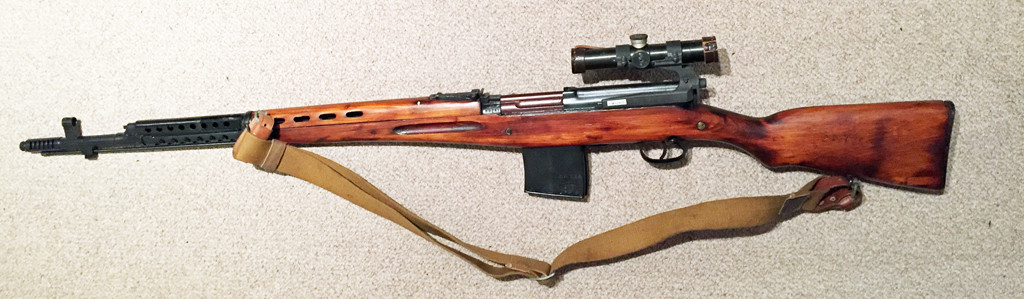
SVT-40 1941 SNIPER with 1941 scope Serial number-M257 (left side)
- In 1939 the Soviets introduced their semi-automatic SVT-38 and some of these were made into snipers. The SVT-38 was redesigned and evolved as the SVT-40. All SVT-40 at the beginning had grooves (mistakenly called “rails” by collectors as they are grooves or slots rather than rails) on the upper body. Those that were selected at the factory had a “squared” notch milled in the upper rear body, usually with a letter stamped inside this notch. Other SVT-40 rifles selected for conversion to sniper rifles in the field had a rounded notch. Later, to simply production of the SVT-40 rifles, the grooves were omitted in the manufacturing process. The telescope usually associated with the SVT sniper rifles was the PU with a “stepped” two diameters tube. This was a very short, lightweight, but tough sniper telescope. On the SVT, the loading of the 10-round magazine was not affected due to the scope sitting to the rear, clear of the loading and ejecting area. The SVT rifles were prized by the Germans and Finns when they captured them, but the Soviets gave up their plans to mass equip their army with SVTs.
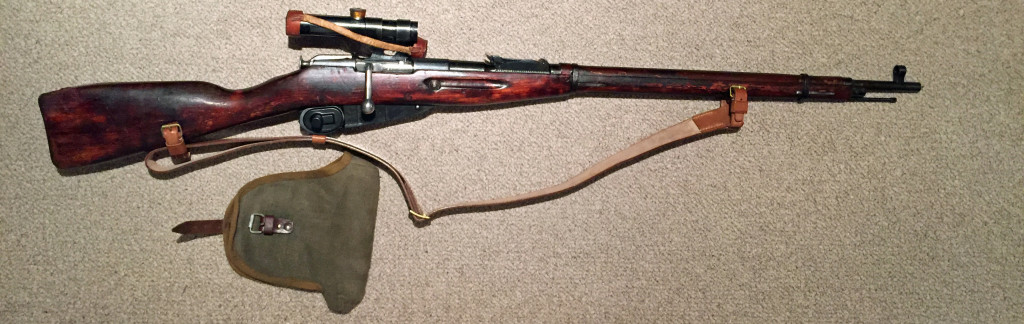
Mosin 91 30 PU sniper Izhevsk 1943
The SVT40 sniper rifles had some problems, specifically with the cold-bore first shot as I recall reading and the Soviets decided to go back tot the bolt-action Mosin 91/30 as their primary sniper rifle. They resumed conversions of the Mosin 91/30 bolt-action rifles. Earlier Mosin sniper rifles had used the PE or PEM scopes, and the later Mosin sniper rifles were equipped with the short PU scopes. At first they used PU scopes that had been removed from SVT sniper rifles, then an even simpler version of the PU scope was produced which had a single diameter tube.
The Soviets had perhaps as many as 250,000 sniper scopes and a similar in WWII and this is believed to be the largest number in the World.
-
RETURN TO RIFLES PAGE
-
Sniper Rifles & Snipers (this page)
-
-
Ross Sniper Rifles
-
Pattern 1914 (later renamed No. 3) Sniper Rifles
-
Lee-Enfield No. 4 Mk. I (T) Sniper Rifle
-
No. 4 (T) Research Database
-
No. 4 Mk. I (T) Sniper Equipment Markings
-
Long Branch Scout Sniper’s Rifle 1943-1944
-
R.E.L. C No. 67 Mk. I sniper scope
-
R.E.L. Scope Case C No. 8 Mk. 2
-
Sniper Scope Tools
-
Sniping Observation Telescopes
-
“Shoot To Live” book 1945 Canadian Army *
-
FN C1A1 Sniper Rifle
-
C3 Sniper Rifle
-
C3A1 Sniper Rifle
-
MacMillan C15 (TAC-50)
-
U.S. M1903A4 Sniper Rifle
-
RETURN TO HOME PAGE
-
-
